Deciding to remove a tree is rarely easy. A mature maple or oak can take decades to grow, and most Rochester homeowners would much rather save a tree than lose it. We feel the same way — removal is always the last option we recommend, not the first. But there are times when taking a tree down is the safe, responsible call, and knowing the difference can protect your home, your family, and your wallet.
This guide walks through the honest warning signs that a tree has reached the end of its life, what a professional takedown actually involves, and how we protect your lawn, fence, and house during the process across Rochester and Monroe County.
When removal is the right call
Some problems can be pruned or treated. Others mean the tree has become a liability that's only going to get more dangerous and more expensive to deal with. Here are the signs that usually point to removal:
- A hollow or cracked trunk. When more than roughly a third of the trunk is hollow or split, the tree has lost the structural core it needs to stand safely.
- Large dead limbs or a dead crown. Big bare branches — what arborists call "widow-makers" — can drop without warning, especially in a Lake Ontario windstorm.
- A worsening lean. A tree that has recently started leaning, with soil heaving or roots lifting on one side, may be failing at the root plate.
- Fungus at the base. Mushrooms or conks growing where the trunk meets the ground often signal advanced internal rot.
- Roots damaging your foundation or driveway. When roots start lifting concrete or threatening your foundation, the tree is in the wrong place to keep.
- Severe storm damage. A tree that's lost major leaders or been split by a storm is usually compromised beyond a safe repair.
Not sure? You don't have to guess. Our ISA-certified arborist will inspect the tree for free and tell you honestly whether it needs to come down or whether pruning can save it.
Signs a tree might be saved instead
Plenty of trees that look scary are actually fine. A few dead branches, surface bark damage, or seasonal leaf drop don't mean a tree is dying. Targeted pruning, cabling for a weak union, or simply giving a young tree time can often keep it healthy for years. That's why we always assess before we recommend — no upselling, no removing a tree that doesn't need to go.
What a professional takedown involves
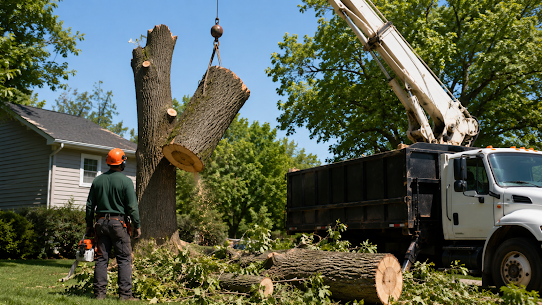
A safe removal is methodical, not dramatic. For most residential jobs in Rochester it looks like this:
- Site assessment. We check the lean, the surrounding structures, power lines, and the best direction to work.
- Controlled rigging. For tight yards we climb or use a bucket and lower limbs piece by piece with ropes, so nothing free-falls onto your home or fence.
- Sectional removal. The trunk comes down in managed sections rather than one big drop whenever space is limited.
- Cleanup & haul-away. We chip the brush, haul the wood, and rake and blow the area so your yard looks better than we found it.
How we protect your property
The details most people never notice are exactly where the skill lives: the way a heavy limb is rigged so it lowers gently instead of crashing, plywood and mats to protect the lawn from equipment, and care taken around flower beds, fences, and septic lines. We're fully licensed and insured, we pull permits where the city requires them, and we call 811 before any stump work that involves digging.
What affects the cost
There's no flat price for tree removal because no two trees are the same. The biggest factors are the tree's height and trunk diameter, its health, and how easy it is to reach. A small tree in an open yard is far cheaper than a large tree wedged between two houses or hanging over power lines. Whatever the job, we give you a clear, fixed written estimate before any work starts — no surprises.
After the removal: what about the stump?
Once the tree is down, you're left with a stump. You can grind it below grade so you can seed or landscape over it, or have it fully extracted with the roots if you plan to build or replant. We'll walk you through both options and what makes sense for your yard.
Thinking about removing a tree?
Get a free, no-pressure assessment from a certified arborist who'll tell you honestly whether it needs to come down.
Get a Free Estimate